
Pandu: Self-Hostable RAG, Measured End to End
Hybrid retrieval measured at recall@5 0.967 on the NIST golden set, with CI gates that fail on any regression — including one gate deliberately left red

- Open-source project
- AI Infrastructure
- Remote
- September 6, 2026
Screenshots
The image could not be loaded.
The image could not be loaded.
The image could not be loaded.
The image could not be loaded.
The problem
Anyone can wire a vector store to an LLM in an afternoon. The difference between that demo and infrastructure is everything around the pipeline: retrieval quality that is measured rather than felt, independence from any vendor, observability, and evaluation that runs in CI — not once, at demo time. Pandu (Indonesian for “guide”) was built to show that difference: every architectural claim in its README is enforced by a CI gate, not merely asserted.
What we built
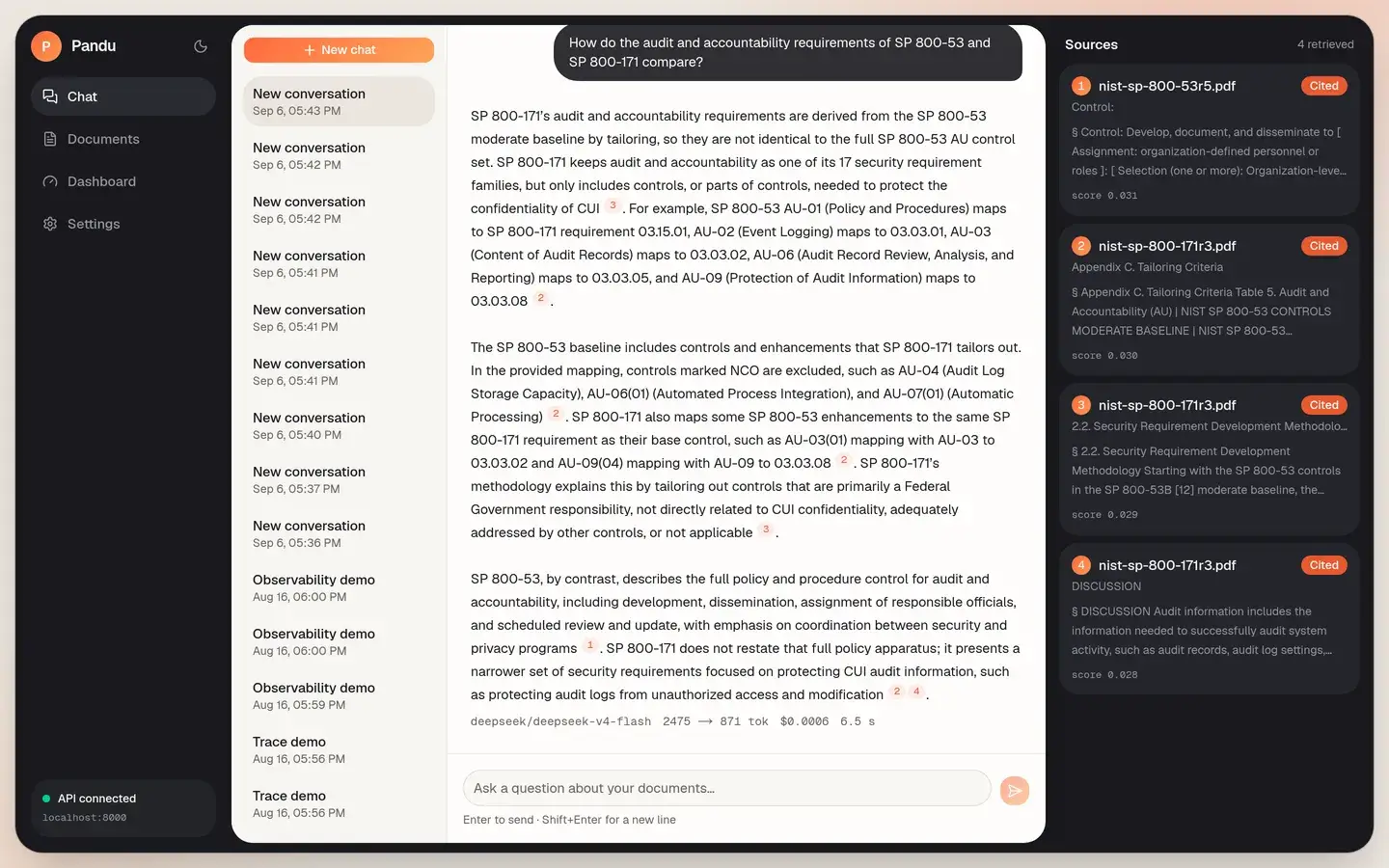
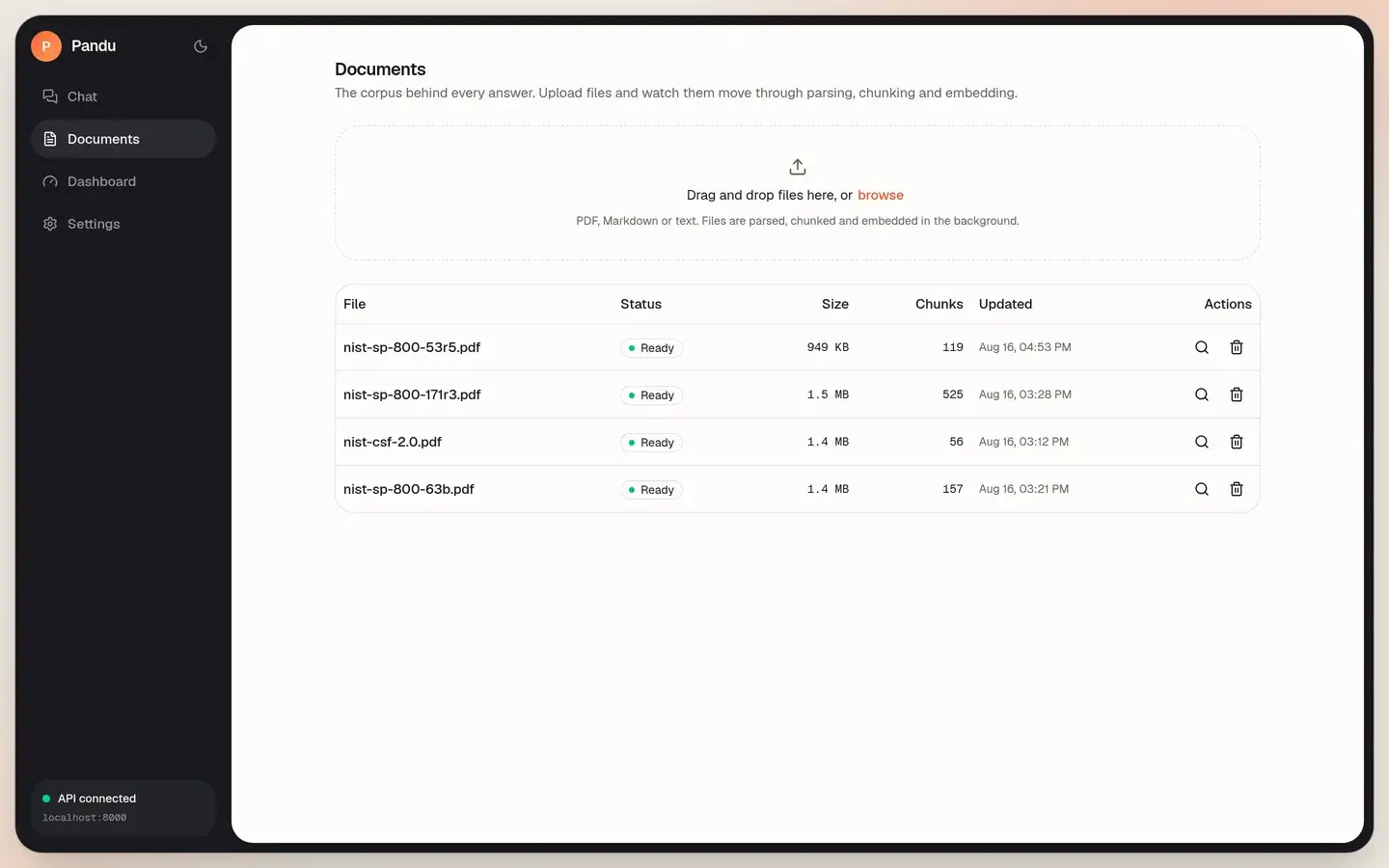
A self-hostable RAG platform: upload documents, ask questions, get streamed answers with
source citations. The backend is a FastAPI modular monolith with import-linter-enforced
module boundaries; a single Postgres holds relational data, vectors (pgvector), and
lexical search (FTS) at once. A question is embedded and searched through two arms in
parallel — dense (HNSW) and lexical — fused with Reciprocal Rank Fusion, then the top
five contexts enter a grounded prompt with numbered [1][2] citations that are
verified in code, not requested in a prompt.
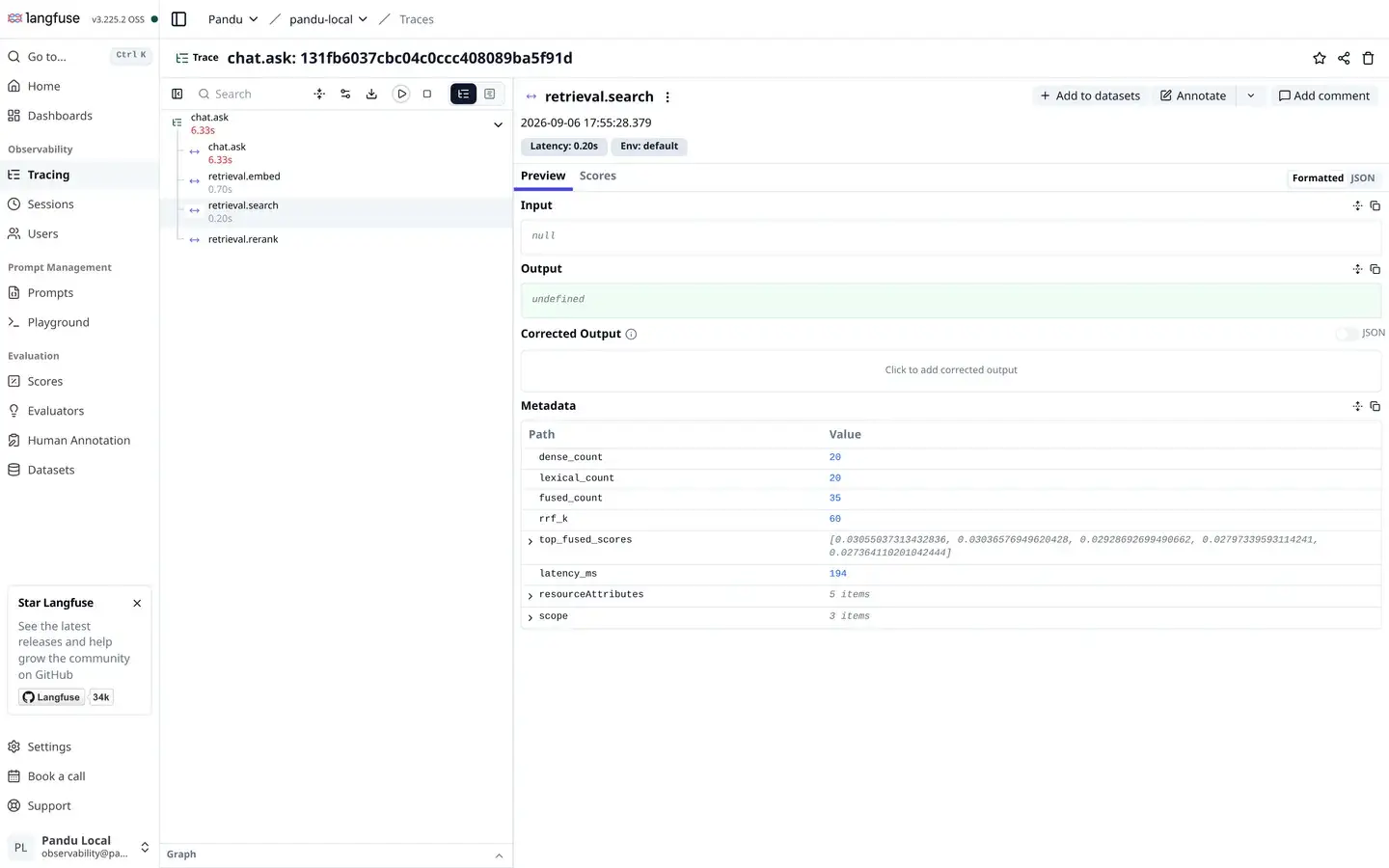
Chat, embeddings, and reranking are three separate ports, so adding a vendor means one adapter file. Observability runs through self-hosted Langfuse (ClickHouse) recording model ids, counts, and latencies — prompt and document text never leave the app.
Engineering decisions
No RAG framework, no gateway SDK. The retrieval pipeline is hand-implemented so every part of it can be measured, and the seam that all API keys flow through is owned outright.
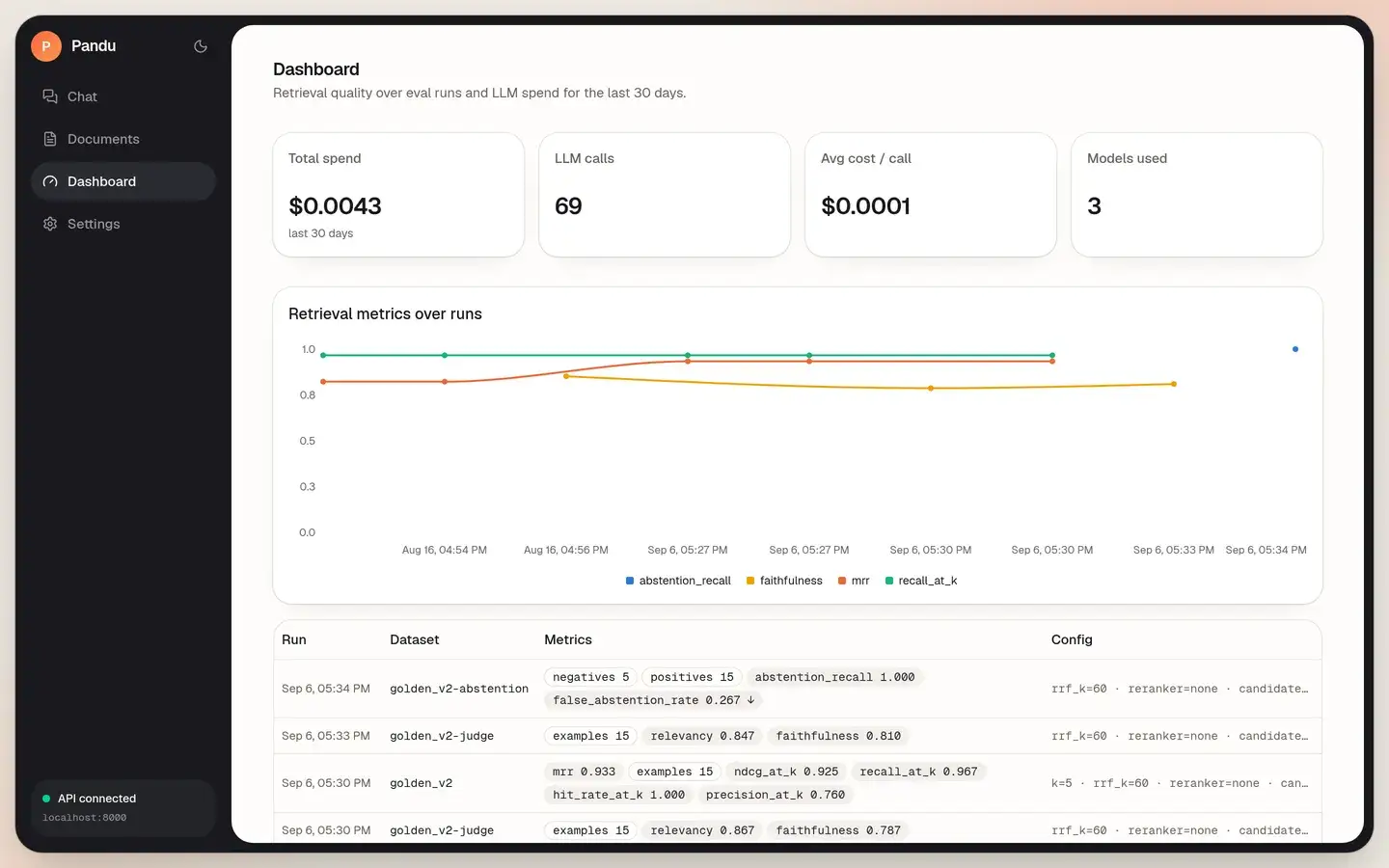
Thresholds ratchet. The CI gates (recall@5 ≥ 0.60; faithfulness ≥ 0.85) may be raised,
never lowered, and --compare fails a run that regresses against the previous stored run
even when every absolute threshold passes — a mean can lie; a diff does not.
Abstention is measured, not prompted. The golden set carries 5 negative questions the corpus genuinely cannot answer, and both error directions are reported separately.
The measured results
On the NIST corpus (golden_v2, 2026-09-06): recall@5 0.967, MRR 0.947, nDCG@5 0.920, abstention recall 1.000. More valuable than the numbers is the story behind them: a configuration sweep found the lexical arm silently empty on 14 of 20 questions — “hybrid” had been running dense-only for three weeks with every test green, caught only when per-arm provenance was read on a single question. After the fix, hybrid actually beats dense (nDCG@1 0.933 vs 0.800).
And one gate is deliberately left red: LLM-judge faithfulness at 0.810 against the 0.85 gate, with a measured diagnosis that cross-document questions (0.543) are the defect. The “obviously right” fix — per-document context caps — was measured and then rejected with numbers, not shipped on the strength of a plausible hypothesis. That is the culture this repo is selling.
Running it
git clone https://github.com/ridwanspace/pandu && cd pandu && make up — the full stack
(web :3000, API :8000, Postgres, Redis) via Docker Compose. The demo needs no API key:
deterministic mock providers run the entire pipeline and are clearly labelled
mock/extractive; add one provider key when you want real generation quality.
Related work



Does your team face a similar problem?
Tell us about the workflow and its constraints. We start with a scope we can describe and verify.