Retrieval-Augmented Generation (RAG) has matured into the standard pattern for enterprise organizations seeking to ground large language models in private corporate knowledge bases. However, as documentation volumes expand from hundreds of prototype files to tens of thousands of production records, the structural limitations of pure dense vector search become painfully evident. Issues such as dropped serial numbers, failure to reconcile dispersed cross-document facts, and fragmented semantic context force data engineering teams to seek higher-order retrieval architectures. The two prominent strategies leading current architectural discussions are Hybrid RAG and GraphRAG.
The first strategy, Hybrid RAG, pairs keyword-driven sparse search (such as BM25 or learned sparse vectors) with dense embedding retrieval using deterministic rank fusion algorithms. The second strategy, GraphRAG, introduced by Microsoft Research, leverages LLMs during the ingestion phase to extract entities, relationships, and hierarchical communities into an explicit knowledge graph before any search occurs. This article compares the mechanics of both systems, provides empirical indexing cost figures and query latency measurements, and delivers an objective decision rubric to evaluate when graph extraction justifies its computational premium.
Why does pure dense vector search fail at enterprise scale?
Pure dense vector search fails at enterprise scale because embedding models compress variable-length text into fixed-dimension vectors that inherently smear exact lexical matches, alphanumeric identifiers, and global relationship structures. During initial proof-of-concept testing on small document corpora, dense search appears reliable because documents are few, semantic overlaps are broad, and user prompts are simple.
When organizations scale their document ingestion to tens of thousands of financial audit filings, compliance policies, and procurement contracts, two critical failure modes emerge:
First, lexical blindness. Dense embedding representations prioritize semantic conceptual similarity over verbatim lexical matching. When an enterprise search query targets an exact part identifier like SKU-8921-X or a statutory clause reference, vector embeddings often retrieve passages discussing related hardware or adjacent regulations while completely missing the exact alphanumeric string.
Second, local context fragmentation. Standard chunking strategies partition long-form documents into discrete segments of 500 to 1,000 tokens. When an executive asks a thematic question such as “What are the primary operational compliance risks identified across all operating subsidiaries this fiscal year?”, individual document chunks contain only localized observations. Cosine similarity matching fails to synthesize an answer because no single passage exhibits high semantic proximity to the broad question.
These fundamental shortcomings created the divide between two engineering philosophies: optimizing text-level retrieval precision through Hybrid RAG, or reconstructing relational data topologies through GraphRAG.
How does the Hybrid RAG architecture resolve vector blind spots?
Hybrid RAG resolves vector blind spots by executing two independent retrieval pipelines in parallel: a lexical pipeline indexed on term frequencies and a semantic pipeline indexed on dense vector embeddings. The resulting candidate lists are then fused into a unified ranking using rank standardization algorithms.
The operational workflow consists of three distinct phases:
-
Sparse Lexical Retrieval: Text chunks are indexed using algorithms like BM25 or learned sparse representations such as SPLADE. This pipeline evaluates exact word occurrences normalized by inverse document frequency (TF-IDF/BM25). It is computationally lightweight, operates with negligible latency, and reliably retrieves exact serial codes, acronyms, and product identifiers without interpretation drift.
-
Dense Semantic Retrieval: In parallel, chunks are converted into dense vector representations using state-of-the-art embedding models. This pipeline identifies conceptual synonyms, implicit user intent, and stylistic phrasing variations that lack direct lexical overlap.
-
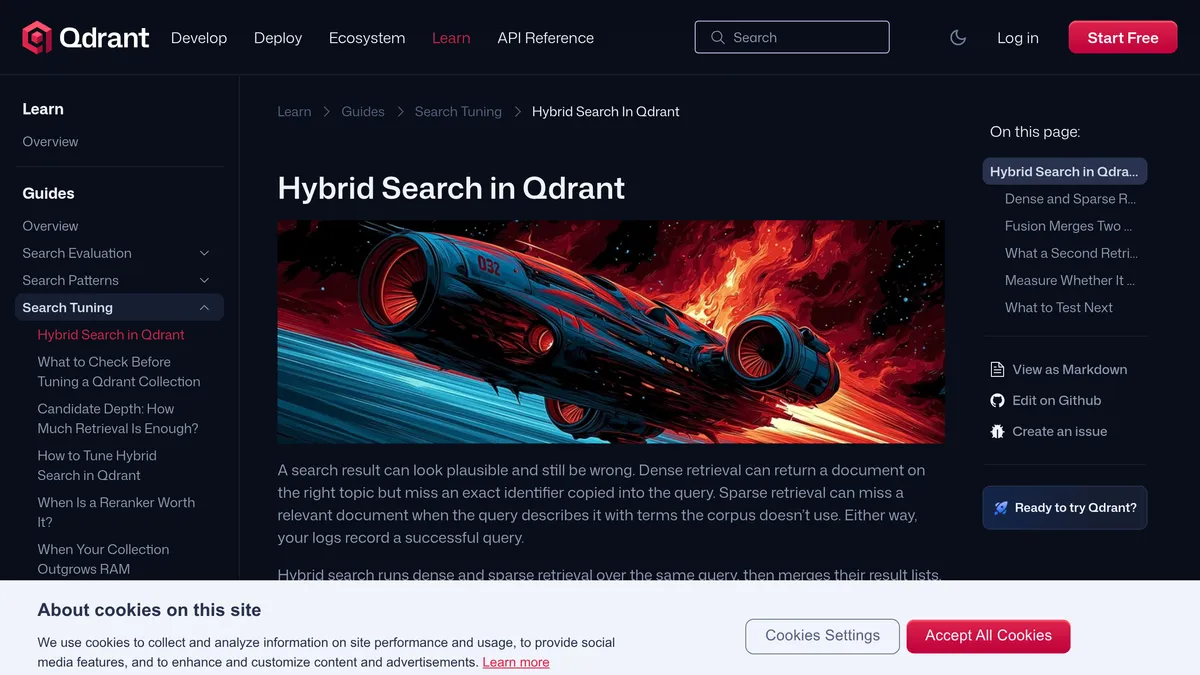
Reciprocal Rank Fusion and Cross-Encoder Reranking: The core strength of Hybrid RAG lies in how candidate lists are consolidated. As documented in the Qdrant technical guide on Hybrid Search, applying Reciprocal Rank Fusion (RRF) standardizes ordinal positions without requiring calibration of mismatched raw similarity scores. The standard RRF scoring function combines ranks as follows:
$$RRF(d) = \sum_{m \in M} \frac{1}{k + r_m(d)}$$
Where $M$ represents the search engines, $r_m(d)$ is the ordinal rank of document $d$ within engine $m$, and $k$ is a smoothing constant (conventionally 60). Following initial RRF candidate selection, a cross-encoder reranker evaluates the top 50 passages against the input query, scoring joint attention before injecting the most relevant context into the LLM prompt.
This architecture is exceptionally cost-effective. Processing an incoming document requires only a single embedding model pass and one inverted index write. No additional generative tokens are burned during data ingestion.
How does GraphRAG build hierarchical knowledge structures?
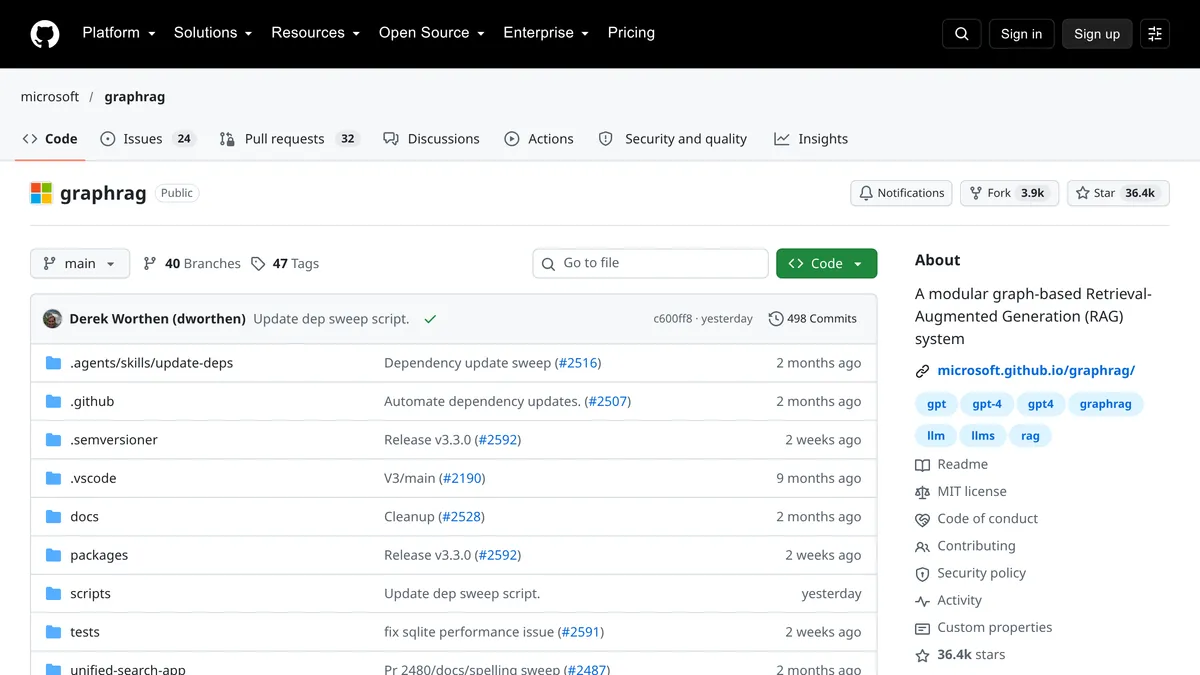
GraphRAG reverses the retrieval paradigm by shifting from raw text passage matching to the traversal of explicit entity-relationship networks. This architecture was formalized in the Microsoft Research scientific paper on GraphRAG and made available via the official Microsoft GraphRAG repository on GitHub.
The GraphRAG indexing pipeline executes an intensive multi-stage workflow:
-
Chunk Decomposition and Entity Extraction: Source documents are segmented into text chunks. Each chunk is passed to an LLM with specialized extraction prompts that identify named entities (people, organizations, locations, concepts, components) alongside typed causal relationships linking those entities.
-
Entity Disambiguation and Deduplication: When multiple documents mention variants of an entity (such as “Agentive Labs” and “PT Agentive Labs Indonesia”), the pipeline executes graph resolution to merge those aliases into a unified canonical node.
-
Hierarchical Community Clustering: Using graph partitioning algorithms such as the Leiden Algorithm, the connected entity graph is segmented into modular community clusters across multiple hierarchical levels. High-level clusters represent macro-level enterprise domains, while sub-communities capture micro-level transactional relationships.
-
Community Summarization: For every identified community cluster, an LLM generates a comprehensive natural language summary detailing key themes, prominent entities, underlying conflicts, and structural connections within the cluster.
-
Local vs Global Search Routines: At query time, GraphRAG supports two operational modes. Local Search explores immediate entity neighborhoods to answer targeted questions (“Who approved procurement order X?”). Global Search queries top-level community summaries in parallel to answer holistic thematic questions (“What are the recurring failure patterns across all warranty claims this quarter?”).
As corroborated in the LlamaIndex documentation on Property Graphs, knowledge graph representations unlock multi-hop reasoning capabilities that pure passage-level retrieval cannot replicate.
Cost, latency, and operational complexity trade-offs
The divergence between Hybrid RAG and GraphRAG is not fundamentally a debate about theoretical answer quality. It is a harsh commercial calculation involving ingestion token expenditure, query response latency, and infrastructure maintenance overhead.
The following table compares key technical and operational dimensions:
| Architectural Dimension | Hybrid RAG (BM25 + Dense + Rerank) | GraphRAG (Microsoft Leiden Hierarchy) |
|---|---|---|
| Ingestion Token Expenditure | Negligible (only embedding API calls) | Substantial (multiple LLM passes per chunk) |
| Ingestion Time (1,000 Documents) | 2 to 10 minutes | 1 to 4 hours |
| User Query Latency | 100ms to 400ms | 1s (Local Search) to 8s (Global Search) |
| Underlying Data Stores | Standard Vector DB (Qdrant, Pgvector, Pinecone) | Vector DB combined with Graph DB (Neo4j / Kùzu) |
| Document Update Agility | Immediate (isolated chunk overwrite/insert) | High friction (triggers graph and summary recalculation) |
| Targeted Fact Retrieval | Exceptional (high lexical and semantic precision) | Moderate (prone to relation hallucination on edge cases) |
| Holistic Thematic Synthesis | Weak (context fragmented across chunks) | Outstanding (pre-aggregated community summaries) |
The ingestion token expense: the unspoken reality
Let us analyze the numbers objectively. In a Hybrid RAG pipeline, indexing a corporate document collection of 10 million tokens (roughly 2,000 dense technical reports) requires only embedding generation. Utilizing modern commercial embedding endpoints at approximately 0.02 USD per 1 million tokens, total ingestion cost ranges between 0.20 and 0.50 USD.
In GraphRAG, every 1,000-token chunk must undergo multiple generative model passes: entity identification, relationship resolution, and community summarization. In benchmarks reported by Microsoft Research, document processing consumes between 5 and 10 times the original token volume in generative reasoning calls. For the identical 10-million-token corpus, running GraphRAG ingestion using modern reasoning models can quickly incur between 150 and 400 USD.
If your document corpus experiences rapid churn with hundreds of files added or updated every hour, this continuous graph re-indexing tax becomes an unsustainable operational line item for most software budgets.
When should you select Hybrid RAG?
Hybrid RAG represents the rational default choice for roughly 85 percent of enterprise retrieval workloads. You should deploy Hybrid RAG when your production scenario matches the following criteria:
-
User Queries Seek Specific Factual Answers: Inquiries focus on concrete, verifiable data points: “What is the late payment penalty in clause 4 of vendor contract X?”, “How is webhook authentication configured on service Y?”, or “What is the spare parts inventory count in the Surabaya depot?”. These queries require lexical precision and localized semantic ranking, not speculative sociological graph traversal.
-
High Document Turnover and Continuous Ingestion: Your knowledge base experiences continuous real-time additions through incoming customer tickets, meeting notes, or inventory adjustments. Adding or invalidating records in Hybrid RAG is an isolated operation that takes milliseconds and never destabilizes global indices.
-
Strict Latency SLAs and Interactive Client Interfaces: The retrieval system powers interactive web or messaging bots (such as WhatsApp customer support) that require initial response streaming within 800 milliseconds. Imposing a 4-to-8-second graph traversal delay degrades the end-user experience.
In our production engagements at the data engineering service and the hybrid-rag-reference project, implementing Hybrid RAG with cross-encoder reranking is the baseline architecture we always benchmark before considering graph-level complexity.
When does GraphRAG justify its premium?
Despite its high computational cost, GraphRAG delivers cognitive synthesis capabilities that standard vector databases cannot match. Specific enterprise domains justify paying the substantial extraction premium:
-
Forensic Audits, Intelligence Analysis, and Fraud Detection: Investigative teams inspect millions of transaction logs, internal emails, and registry documents to trace concealed ownership structures. The question is rarely about a single isolated transaction; it asks: “What indirect connections link shell company A to political figure B through intermediary parties?”. This is a multi-hop graph traversal challenge that passage search cannot resolve.
-
Broad Thematic Sensemaking Across Large Corpora: Executive leadership seeks strategic analysis across thousands of customer interviews or competitor filings: “What are the primary operational friction themes reported across all regions this fiscal half, and which software subsystems are most frequently implicated?”. GraphRAG answers this query by aggregating pre-computed community summaries without attempting to scan the entire raw corpus on the fly.
-
High-Value, Static Knowledge Repositories: Documents remain unchanged over years, such as national legal statutes, aerospace technical manuals, or nuclear safety specifications. Because ingestion expenditure occurs once up front, the cost per query amortizes cleanly over the multi-year lifecycle of the system.
The hybrid-graph router pattern: an architectural compromise
For organizations that need relational reasoning without enduring continuous full-graph latency and cost, the superior design pattern is a Tiered Hybrid-Graph Router.
The architectural topology separates concerns pragmatically:
flowchart TD
  Query["User Input Query"] --> Router["Intent Classification Component (Router)"]
  Router -->|Specific Factual Query| Tier1["Tier 1: Fast Hybrid RAG<br/>BM25 Sparse + Dense Vector + Reranker"]
  Router -->|Thematic / Multi-Hop Synthesis| Tier2["Tier 2: GraphRAG Traversal<br/>Entity Neighborhoods + Community Summaries"]
  Tier1 -->|Rapid Context ~250ms| Synth["Final Context Synthesis (LLM Generator)"]
  Tier2 -->|Relational Context ~2.5s| Synth
A lightweight semantic router evaluates incoming query intent. If the query targets specific facts, it routes to Tier 1 (Hybrid RAG) for rapid, low-cost resolution. Only when a query demands relational synthesis or multi-hop tracing does the router invoke Tier 2 graph traversal.
By deploying this tiered routing pattern, 90 percent of routine traffic resolves through the fast, economical Hybrid RAG pipeline, while advanced graph synthesis remains on standby for complex analytical inquiries.
Practical guidance for your data stack
Selecting between Hybrid RAG and GraphRAG is not an exercise in chasing the newest research release. It is an engineering discipline that balances query intent, update velocity, and computational unit economics.
Constructing automated knowledge graphs over raw documents requires meticulous data engineering. If your current implementation relies on pure dense vector search and frequently fails on specific keyword queries, jumping immediately to GraphRAG is usually the wrong move. The empirically proven first step is implementing Hybrid RAG: combine BM25 sparse indices with dense embeddings, integrate Reciprocal Rank Fusion, and evaluate candidates with a cross-encoder reranker. This enhancement routinely eliminates 90 percent of retrieval defects at a fraction of the cost of a full graph implementation.
Only when your core business requirements explicitly demand cross-document thematic synthesis or multi-hop entity traversal should you commit budget to GraphRAG pipeline development.
If your organization is architecting an enterprise RAG pipeline, encountering accuracy limits in internal document search, or looking to deploy a scalable hybrid data architecture, connect with our engineering practitioners through our contact page.