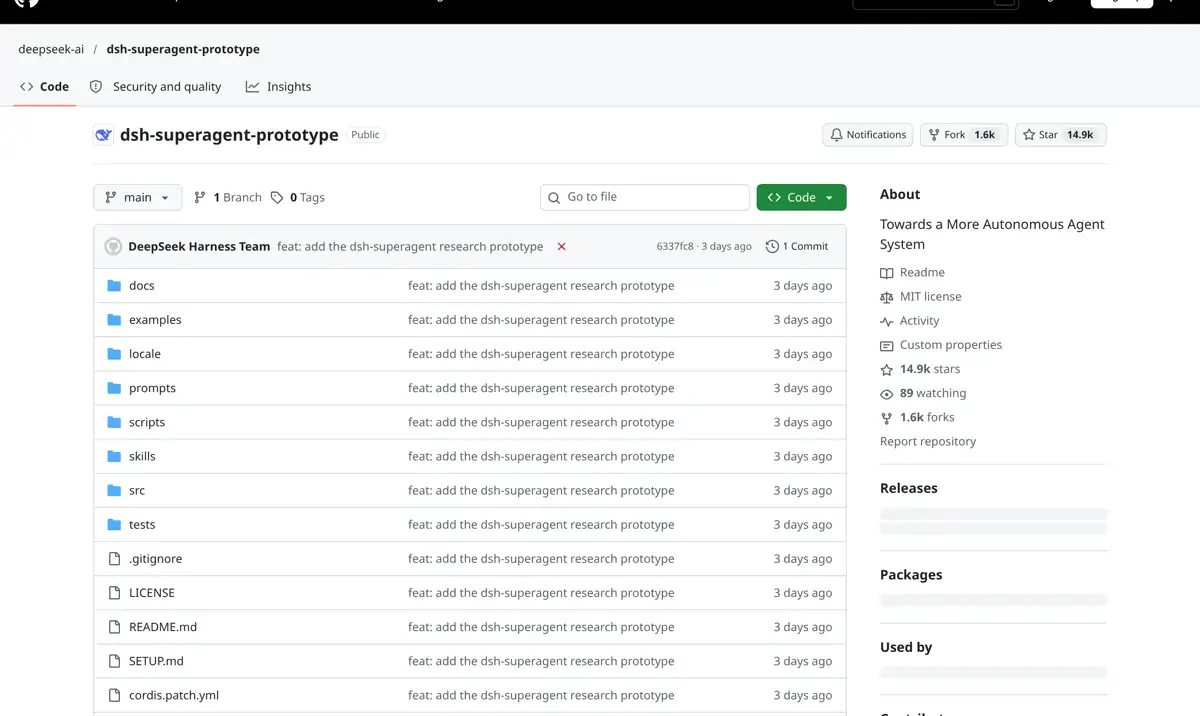
On October 31, 2026, the DeepSeek Harness team open-sourced a prototype called dsh-superagent: a coding agent that does not wait to be called. It listens to events on a GitHub repository, opens its own work items, does the work in an isolated session and directory, then answers directly in the conversation that asked for it, usually as a pull request. As important as the release itself: its own README calls it a research prototype for reference only, not an official DeepSeek product and not production-ready. This summary is assembled from the two official repositories and the DeepSeek product page, which we checked on November 3, 2026.
What did DeepSeek actually launch?
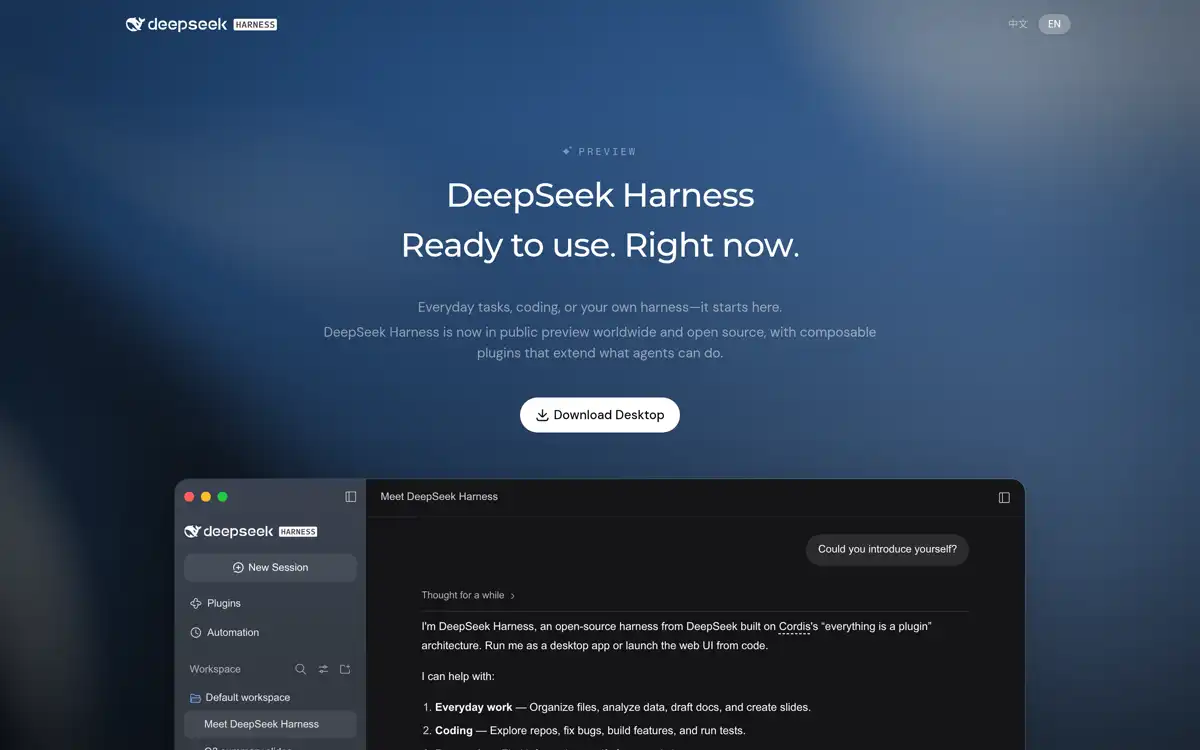
Two artifacts, at two different times. The first is DeepSeek Harness itself: an MIT-licensed open-source agent runtime built on the principle that “Everything is a Plugin”, layered on the Cordis library, and running as a worldwide public preview on its official page since August 2026. The runtime ships a CLI named dsh and a desktop app; its repository already records 25,588 commits and roughly 270 thousand GitHub stars. The second is dsh-superagent-prototype, a “research bundle” announced by the Harness team at the end of October 2026 and uploaded as a single commit: “feat: add the dsh-superagent research prototype”.
Worth stating upfront: this prototype is not the public version of an internal DeepSeek product. Its README says the published code was adapted specifically for release, differs from their internal version, and that some designs in its companion article, “Towards a More Autonomous Agent System”, are not implemented yet. Part of the code was even written by coding agents themselves, and the README concedes that this can mean bugs.
How does this proactive agent work?
Its loop turns on one circle: listen, authorize, work, report. The prototype README explains that the agent listens to GitHub events, issues and pull requests, plus Feishu messages optionally. When an authorized person asks for work, it opens a work item and acts on it in its own agent session, in an isolated working directory, then replies in the original conversation where the request came from, usually with a pull request. A web panel collects the things that need human attention.
Two behavior rules from the README are the most interesting part for teams designing automation. First, the agent acts only when asked or when a team-written rule permits; it does not improvise about when it may work. Second, it speaks only when someone must act or can use the result. This is philosophy, not a minor feature: the pattern of “act only inside written authorization boundaries” is the same guard pattern we build for agents with MCP access.
flowchart TD
  A["GitHub event or Feishu message"] --> B{"Do team authorization rules allow it?"}
  B -->|"No"| C["The agent stays silent"]
  B -->|"Yes, or an explicit request"| D["A work item is opened"]
  D --> E["Isolated agent session and working directory"]
  E --> F["Reply in the original conversation, e.g. a pull request"]
  F --> G["Web panel: the queue needing human decisions"]
The internal architecture, such as the router and worker split that several reports mention, is documented in numbered docs inside the docs folder: philosophy, domain model, authorization, execution, prompts, panel, deployment, architecture, and a cookbook. We have not run this prototype, so our account here stays faithful to the README rather than to our own test results.
How does it differ from existing coding agents?
The real divider is not intelligence; it is the trigger model. Popular coding agents today work reactively: an engineer opens a session, hands over a task, the agent works, the session ends. This prototype is built to be proactive within limits: it subscribes to events, opens its own work items when the rules allow, and its work persists until it reports back done. Several reports place it alongside Claude Code and Codex-style agents; from the README itself, the fairer comparison is with the category of “listening agents”, not with any specific language model.
The honest comparison should run on criteria you can verify yourself, and these are our criteria, not DeepSeek’s claims:
- Trigger: a manual session versus repository events and team messages.
- Unit of work: one task per session versus a work item that lives until resolved.
- Oversight surface: terminal history versus a web panel holding an attention queue.
- Action boundaries: team conventions versus written authorization rules in configuration.
- Maturity: production versus a research prototype with explicit warnings.
If your team already uses a daily coding agent, this prototype reads as a direction experiment: what if the agent subscribed to the repository instead of only being summoned. The experiment is valuable precisely because the code is readable.
What does one work cycle look like in practice?
This is an illustrative scenario we assembled from the README’s description, not a run we executed. Picture an internal repository with a team rule: the agent may work on issues labeled triage, at the request of two maintainers. On a Monday morning, QA files a bug-replication issue and applies the label. The event arrives, the rule permits, and the prototype opens one work item in its queue. It clones the repository into its own working directory, reads the issue and the surrounding code, then writes a replication attempt until the failure is consistent. Its output is one pull request containing a regression test and, if the root cause is clear, one candidate fix. Its answer appears in the same issue thread: what it found, what it changed, and what it left untouched. The web panel marks that pull request as an item waiting for a human decision; the maintainer reviews it like any contributor PR, merging or requesting changes.
Two things in this scenario deserve to be read as they are. First, every step that touches code still ends in a pull request, which means the merge decision stays with a human; this prototype does not push anything straight to the main branch. Second, the README promises nothing about the quality of its output; the only public measure available is that its own team calls this code a research prototype.
The context: the Harness runtime underneath
The prototype is a plugin on top of DeepSeek Harness, and that matters for judging its reach. Harness applies an everything-is-a-plugin principle over Cordis, with the dsh CLI; the command npx @deepseek-ai/dsh web brings up a local web interface. The license is MIT. What to note for planning: the Harness repository itself still carries the preview phase label with a warning about compatibility-breaking changes, and recent commits show package versions still on the 0.2.2-alpha.3 path. Adoption numbers are large, about 270 thousand stars and 32.9 thousand forks, but a preview phase means the APIs are not yet promised to be stable.
What is not ready for production?
A lot, and its README says so, not us. The explicit points: this prototype is for research reference only, not an official DeepSeek product; part of its code was produced by coding agents and may contain bugs; the published version was adapted and differs from the internal version and from the companion article; and some designs in that article are not implemented at all. Add the Harness preview phase, where compatibility can break, and the technical conclusion is simple: do not point this prototype at production repositories without strict separation.
For teams that want to evaluate it themselves, here is the order we suggest, as an editorial checklist rather than an official DeepSeek guide:
- Run the pilot in a separate organization or repository holding synthetic data, far from production.
- Read the authorization and execution docs in the docs folder before writing a single rule; the authorization rules are its attack surface.
- Start with one event type only, say a comment from one authorized person, before enabling broader listeners.
- Decide who closes the panel queue; a proactive agent without an owner for the attention queue only moves work around instead of reducing it.
- Lock the approval path: its output is a pull request, so treat every PR as one from a foreign contributor you have not met yet.
The patterns above, written permissions, isolated execution, human approval at risky points, are patterns we work with every day in our AI agents service, regardless of the runtime chosen.
What does this article not cover?
Three things. First, the README does not name the model version the prototype uses, so we quote no model claims. Second, the October 31, 2026 date combines the GitHub commit timestamp, three days before our check, with consistent public reporting; we did not find a dated official announcement page, so treat that date as a strong estimate. Third, we did not run the prototype, measure its pull-request quality, or quote performance numbers from anyone. All sources were checked on November 3, 2026. If you want to weigh proactive-agent patterns for your internal workflows, talk to us.